
The National President of the Nigeria Union of Teachers (NUT), Comrade Audu Titus Amba, has raised concerns with the Registrar of the Joint Admissions and Matriculation Board, Professor Is-haq Oloyede, over the Federal Government’s decision to exempt candidates seeking admission into National Certificate in Education (NCE) and non-technology agricultural programmes from the Unified Tertiary Matriculation Examination (UTME).
The issue featured prominently during a courtesy visit by the NUT leadership to JAMB’s national headquarters in Bwari, Abuja, where both parties discussed challenges facing teacher education and strategies for strengthening the teaching profession in Nigeria.
Speaking during the meeting, Amba reiterated the union’s opposition to the policy, arguing that exempting prospective NCE students from the UTME could undermine efforts to promote excellence and professionalism in teaching.
According to him, removing the competitive admission process may create the impression that teaching requires lower academic standards than other professions, thereby portraying the sector as a destination for candidates unable to secure admission into other disciplines.
The NUT president also faulted the process leading to the policy, stating that key stakeholders, including the teachers’ union, were not adequately consulted before the decision was announced.
He maintained that government should focus on addressing the root causes of declining enrolment in Colleges of Education through improved welfare packages, scholarships, professional development opportunities, mentorship programmes and incentives designed to attract high-performing students into the teaching profession.
Amba noted that despite years of advocacy by the union, the extension of teachers’ retirement age and years of service remains one of the few significant gains recorded for educators nationwide.
He assured that the union would continue engaging relevant authorities, including the National Assembly, to secure better remuneration, enhanced welfare and improved working conditions for teachers across the country.
The NUT leader, however, commended Oloyede for his commitment to advancing teacher education and pledged that several of the recommendations offered by the JAMB registrar would be incorporated into the union’s future policy advocacy efforts.
Responding, Oloyede urged the union to intensify its engagement with government and other stakeholders in advocating policies that would improve teachers’ welfare and make the profession more attractive and competitive.
He observed that declining enrolment in NCE-awarding institutions remains a major concern and stressed the need for coordinated efforts to restore public confidence and prestige in the teaching profession.
The JAMB registrar reaffirmed his commitment to strengthening teacher education, describing it as a critical pillar for national growth and development.
Addressing concerns over the UTME exemption policy, Oloyede clarified that he would never support any initiative capable of diminishing the status or quality of the teaching profession.
He noted that throughout his career as an educator, his efforts have consistently focused on promoting teaching as a respected, competitive and highly sought-after profession.
To underscore his position, Oloyede referenced scholarly papers he authored on teacher education, including “Strengthening Teacher Preparation in Nigeria: Admission and Contents Consolidation” and “Dwindling Enrolment in NCE-Awarding Institutions in Nigeria: The Way Forward.”
He encouraged the union to study and utilise the recommendations contained in the publications to strengthen its advocacy and contribute to ongoing reforms in teacher education.
WASSCE: Akeem Lasisi Highlights Common Mistakes Candidates Make in Informal Letter Writing
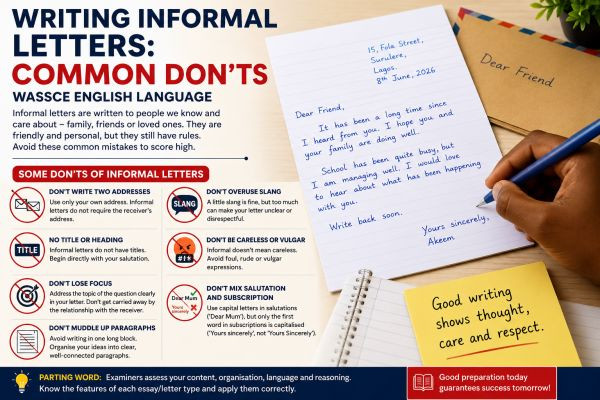
As candidates prepare for the English Language paper in the ongoing West African Senior School Certificate Examination (WASSCE), language expert and educator, Akeem Lasisi, has outlined common mistakes students should avoid when writing informal letters.
Lasisi, in an educational article published on Monday, noted that despite rapid technological advancement and changing communication platforms, letter writing remains a vital aspect of written communication and an important component of English language examinations.
According to him, informal letters are generally easier to write because they are addressed to family members, friends, and acquaintances, allowing for a more relaxed tone than formal correspondence. However, he cautioned that many candidates lose valuable marks by misunderstanding the basic rules governing the format.
Avoid Using Two Addresses
One of the most common errors, Lasisi explained, is the inclusion of two addresses. Unlike formal letters, which require both the sender’s and recipient’s addresses, informal letters require only the writer’s address and date.
Do Not Add a Title
He also advised candidates against adding a title or heading to an informal letter. While formal letters often carry a subject heading, informal letters begin directly with a salutation such as “Dear Mum” or “Dear Friend.”
Stay Focused on the Question
Lasisi stressed the importance of addressing the specific topic given in the examination question. Candidates must clearly understand the purpose of the letter and develop their ideas accordingly.
Whether the task involves narrating an experience, describing an event, discussing family matters, or explaining future plans, students should remain focused on the central theme throughout the letter.
“Being familiar with the recipient should not distract candidates from addressing the requirements of the question,” he noted.
Organise Ideas into Clear Paragraphs
The language expert further warned against writing the entire letter as a single block of text. He encouraged students to organise their thoughts into logical and coherent paragraphs to enhance readability and clarity.
Limit the Use of Slang
Although informal letters permit a conversational tone, excessive use of slang expressions should be avoided. According to Lasisi, overusing slang can make a letter appear unclear and less effective.
Avoid Vulgar or Careless Language
He also reminded candidates that informality does not justify poor language use. Vulgar expressions, offensive remarks, and careless writing should be avoided, even when addressing close friends or relatives.
Observe Proper Letter Conventions
Lasisi highlighted another frequent error involving the salutation and subscription. While salutations such as “Dear Mum” require capital letters, subscription phrases should follow standard conventions.
Examples include “Yours sincerely,” “Your loving son,” and “Your dear daughter,” where only the first word begins with a capital letter.
Master Essay Writing Techniques
Offering broader examination advice, Lasisi urged candidates to remember that English language examiners assess not only content but also reasoning ability, organisation, grammar, and mastery of language.
He advised students to familiarise themselves with the unique features of various essay types, including argumentative essays, debates, speeches, and letters, to maximise their performance in the examination.
With thousands of candidates set to sit for the English Language paper, the guidance serves as a timely reminder that attention to structure, clarity, and language conventions remains essential for success.
Download our Mobile App for easy access
https://play.google.com/store/apps/details?id=com.edutvmobile.ng&hl=en
Mobile App Lite
https://play.google.com/store/apps/details?id=com.edutvng.lite
https://play.google.com/store/apps/details?id=com.edutvmobile.ng&hl=en
Follow us on Youtube
https://youtube.com/@edutvnigeria
Follow us on LinkedIn -
https://ng.linkedin.com/company/edutvnigeria
Follow us on Instagram
https://instagram.com/edutvnigeria
Follow us on Facebook
https://www.facebook.com/edutvnigeria