
A Professor of Industrial Sociology at Ekiti State University (EKSU), Prof. Lukman Adesida, has called for urgent reforms of Nigeria’s retirement and pension system, warning that the country risks a worsening socio-economic crisis if it fails to address the realities of an ageing population, changing work patterns and poor retirement planning.
Adesida made the call while delivering the 106th inaugural lecture of EKSU titled, “Skin Trade, Sociological Imagination and Life Scripts: The Paradox in the Triad of Work, Retirement and Pension.”
The don argued that retirement should no longer be viewed as a personal transition but as a critical national issue closely linked to governance, labour policies and social welfare systems.
According to him, retirement planning should begin from the moment an individual secures employment, noting that inadequate preparation during a worker’s active years often results in financial hardship, loss of identity and social isolation in retirement.
He observed that many retirees face not only economic challenges but also psychological difficulties as they adjust from active professional lives to diminished social engagement and relevance.
Prof. Adesida expressed concern over the state of Nigeria’s pension system, describing it as overstretched and in need of comprehensive reforms to restore confidence and ensure long-term sustainability.
He stressed that pension administration should be regarded as a social contract among government, employers and workers, warning that inconsistent policies and poor implementation continue to erode public trust in the system.
The sociologist further highlighted global demographic trends showing a steady rise in the ageing population, particularly in developing countries, including Nigeria. He noted that the nation is yet to adequately prepare for the economic and social consequences of this shift.
Without proactive intervention, he warned, the responsibility of caring for the elderly could place an unsustainable burden on both families and government institutions.
Adesida also challenged the traditional model of single-career employment, urging policymakers to embrace and legally support multiple-income and multi-job structures as a practical response to the realities of a rapidly changing economy.
He advised younger workers to acquire diverse skills and prepare for flexible career pathways that can provide financial security throughout their working lives and beyond.
Beyond financial considerations, the professor advocated greater social inclusion for retirees through structured mentorship programmes, advisory roles and community engagement initiatives.
According to him, such measures would help retirees remain productive, reduce social isolation and preserve their sense of identity and purpose after leaving active service.
Among his recommendations were early retirement planning from mid-career, transparent and reliable pension reforms, strengthened social welfare programmes for senior citizens and broad stakeholder engagement in pension policy formulation.
He emphasised that reforms must protect both current contributors and future retirees while ensuring policy changes are clearly communicated and fairly implemented.
Adesida concluded that retirement should be treated as a collective societal responsibility rather than an individual burden, noting that a nation's treatment of its elderly citizens reflects the strength of its social and economic institutions.
Responding, EKSU Vice-Chancellor, Prof. Babatola Ayodele, described the lecture as insightful and timely, saying it shed light on the sociological dimensions of retirement, pension administration and life after active service.
Ayodele commended the inaugural lecturer for his contributions to scholarship and policy discourse, reaffirming the university’s commitment to the prompt payment of retirees’ benefits and the smooth transition of staff into retirement.
WASSCE: Akeem Lasisi Highlights Common Mistakes Candidates Make in Informal Letter Writing
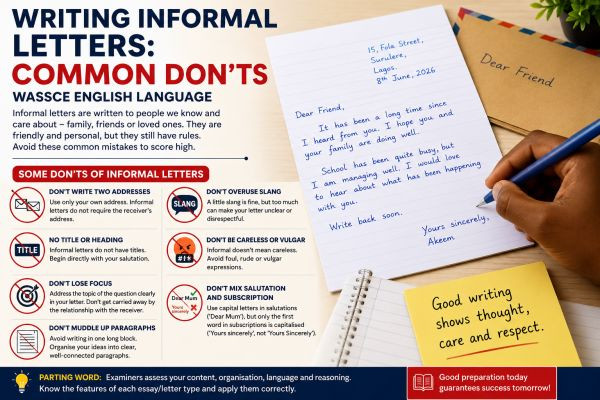
As candidates prepare for the English Language paper in the ongoing West African Senior School Certificate Examination (WASSCE), language expert and educator, Akeem Lasisi, has outlined common mistakes students should avoid when writing informal letters.
Lasisi, in an educational article published on Monday, noted that despite rapid technological advancement and changing communication platforms, letter writing remains a vital aspect of written communication and an important component of English language examinations.
According to him, informal letters are generally easier to write because they are addressed to family members, friends, and acquaintances, allowing for a more relaxed tone than formal correspondence. However, he cautioned that many candidates lose valuable marks by misunderstanding the basic rules governing the format.
Avoid Using Two Addresses
One of the most common errors, Lasisi explained, is the inclusion of two addresses. Unlike formal letters, which require both the sender’s and recipient’s addresses, informal letters require only the writer’s address and date.
Do Not Add a Title
He also advised candidates against adding a title or heading to an informal letter. While formal letters often carry a subject heading, informal letters begin directly with a salutation such as “Dear Mum” or “Dear Friend.”
Stay Focused on the Question
Lasisi stressed the importance of addressing the specific topic given in the examination question. Candidates must clearly understand the purpose of the letter and develop their ideas accordingly.
Whether the task involves narrating an experience, describing an event, discussing family matters, or explaining future plans, students should remain focused on the central theme throughout the letter.
“Being familiar with the recipient should not distract candidates from addressing the requirements of the question,” he noted.
Organise Ideas into Clear Paragraphs
The language expert further warned against writing the entire letter as a single block of text. He encouraged students to organise their thoughts into logical and coherent paragraphs to enhance readability and clarity.
Limit the Use of Slang
Although informal letters permit a conversational tone, excessive use of slang expressions should be avoided. According to Lasisi, overusing slang can make a letter appear unclear and less effective.
Avoid Vulgar or Careless Language
He also reminded candidates that informality does not justify poor language use. Vulgar expressions, offensive remarks, and careless writing should be avoided, even when addressing close friends or relatives.
Observe Proper Letter Conventions
Lasisi highlighted another frequent error involving the salutation and subscription. While salutations such as “Dear Mum” require capital letters, subscription phrases should follow standard conventions.
Examples include “Yours sincerely,” “Your loving son,” and “Your dear daughter,” where only the first word begins with a capital letter.
Master Essay Writing Techniques
Offering broader examination advice, Lasisi urged candidates to remember that English language examiners assess not only content but also reasoning ability, organisation, grammar, and mastery of language.
He advised students to familiarise themselves with the unique features of various essay types, including argumentative essays, debates, speeches, and letters, to maximise their performance in the examination.
With thousands of candidates set to sit for the English Language paper, the guidance serves as a timely reminder that attention to structure, clarity, and language conventions remains essential for success.
Download our Mobile App for easy access
https://play.google.com/store/apps/details?id=com.edutvmobile.ng&hl=en
Mobile App Lite
https://play.google.com/store/apps/details?id=com.edutvng.lite
https://play.google.com/store/apps/details?id=com.edutvmobile.ng&hl=en
Follow us on Youtube
https://youtube.com/@edutvnigeria
Follow us on LinkedIn -
https://ng.linkedin.com/company/edutvnigeria
Follow us on Instagram
https://instagram.com/edutvnigeria
Follow us on Facebook
https://www.facebook.com/edutvnigeria