
The Federal Government has intensified efforts to improve child health and educational outcomes with the launch of a nationwide advocacy campaign aimed at increasing immunisation coverage, reducing preventable diseases and strengthening human capital development.
The initiative was unveiled on Wednesday by the Minister of Education, Dr. Olatunji Alausa, during the maiden edition of the Kids Dialogue Series held at Government Science Secondary School, Pyakasa, Abuja.
The programme, themed “Empowering Youth Voices to Shape Health, Learning and Well-being in Nigeria,” brought together students, health professionals, education stakeholders and policymakers to promote awareness of preventive healthcare and the importance of childhood immunisation.
Addressing students at the event, Alausa emphasised the strong link between health and education, warning that gaps in immunisation coverage continue to affect school attendance, academic performance and national productivity.
“Your health is Nigeria’s first exam,” the minister told the students, urging them to know their vaccination status and embrace healthy practices that protect them from preventable diseases.
The event featured moving testimonies from survivors of vaccine-preventable illnesses, some of whom recounted experiences of prolonged hospitalisation, blindness, hearing impairment, physical disabilities and months spent in wheelchairs.
According to the minister, the testimonies were intentionally included to help students understand the real-life consequences of inadequate vaccination and encourage positive health-seeking behaviour.
“These conditions could have been avoided. Hearing these stories directly made a strong impact on the students,” he said.
Alausa noted that child health remains central to the Federal Government’s education reform agenda, stressing that healthy children are more likely to stay in school, learn effectively and contribute meaningfully to national development.
He said the administration of President Bola Ahmed Tinubu is committed to building a healthier and more educated population through integrated health and education policies.
“Our children are the future leaders of this country. They must be healthy, educated and globally competitive,” he stated.
The minister highlighted ongoing efforts to expand routine immunisation against diseases such as measles and polio, while also promoting the uptake of the Human Papillomavirus (HPV) vaccine, which helps prevent certain forms of cancer.
“We now have vaccines that can prevent cancer. The HPV vaccine is one of them,” he added.
Health experts at the event reiterated that improved vaccine uptake remains essential for reducing child mortality rates and ensuring healthier futures for Nigerian children.
The programme attracted representatives of the National Primary Health Care Development Agency, education sector stakeholders, civil society organisations and health advocacy groups.
Alausa commended the collaboration among partners, describing it as critical to strengthening school-based health education and increasing immunisation awareness among children and adolescents.
He also announced plans to expand the Kids Dialogue Series to schools across the country as part of a sustained national advocacy campaign.
“This is not a one-time event. We will continue this engagement across Nigeria,” he said.
The minister further encouraged students to embrace healthy lifestyles, including regular handwashing, balanced nutrition, routine medical check-ups and vaccination, describing them as key pillars of disease prevention.
Earlier, the Executive Director and Chief Executive Officer of the NPHCDA, Dr. Muyi Aina, urged students to become ambassadors for healthy living by promoting positive health behaviours within their schools and communities.
He explained that primary healthcare and immunisation programmes are designed to protect children from preventable diseases and ensure healthier, more productive lives.
“My responsibility includes ensuring primary healthcare services for all of you, including immunisation,” he said.
During an interactive session, Aina engaged students on their vaccination status, particularly regarding the HPV vaccine, and emphasised the importance of taking personal responsibility for health and well-being from an early age.
He also called for stronger collaboration between the education and health sectors to improve school-based healthcare programmes and encouraged students and teachers to actively contribute ideas that can shape public health policies.
The event concluded with an open dialogue session during which students shared concerns and asked questions about healthcare access, immunisation and other health-related issues affecting young people.
WASSCE: Akeem Lasisi Highlights Common Mistakes Candidates Make in Informal Letter Writing
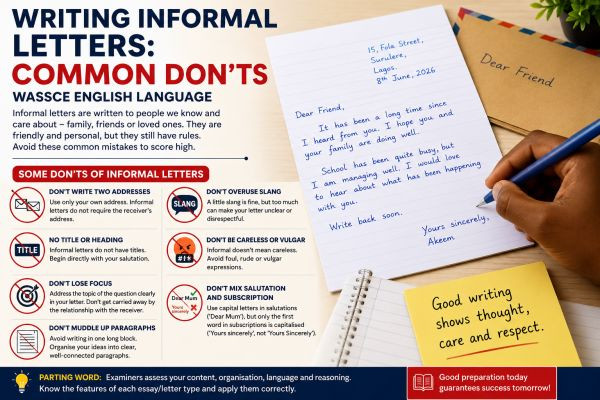
As candidates prepare for the English Language paper in the ongoing West African Senior School Certificate Examination (WASSCE), language expert and educator, Akeem Lasisi, has outlined common mistakes students should avoid when writing informal letters.
Lasisi, in an educational article published on Monday, noted that despite rapid technological advancement and changing communication platforms, letter writing remains a vital aspect of written communication and an important component of English language examinations.
According to him, informal letters are generally easier to write because they are addressed to family members, friends, and acquaintances, allowing for a more relaxed tone than formal correspondence. However, he cautioned that many candidates lose valuable marks by misunderstanding the basic rules governing the format.
Avoid Using Two Addresses
One of the most common errors, Lasisi explained, is the inclusion of two addresses. Unlike formal letters, which require both the sender’s and recipient’s addresses, informal letters require only the writer’s address and date.
Do Not Add a Title
He also advised candidates against adding a title or heading to an informal letter. While formal letters often carry a subject heading, informal letters begin directly with a salutation such as “Dear Mum” or “Dear Friend.”
Stay Focused on the Question
Lasisi stressed the importance of addressing the specific topic given in the examination question. Candidates must clearly understand the purpose of the letter and develop their ideas accordingly.
Whether the task involves narrating an experience, describing an event, discussing family matters, or explaining future plans, students should remain focused on the central theme throughout the letter.
“Being familiar with the recipient should not distract candidates from addressing the requirements of the question,” he noted.
Organise Ideas into Clear Paragraphs
The language expert further warned against writing the entire letter as a single block of text. He encouraged students to organise their thoughts into logical and coherent paragraphs to enhance readability and clarity.
Limit the Use of Slang
Although informal letters permit a conversational tone, excessive use of slang expressions should be avoided. According to Lasisi, overusing slang can make a letter appear unclear and less effective.
Avoid Vulgar or Careless Language
He also reminded candidates that informality does not justify poor language use. Vulgar expressions, offensive remarks, and careless writing should be avoided, even when addressing close friends or relatives.
Observe Proper Letter Conventions
Lasisi highlighted another frequent error involving the salutation and subscription. While salutations such as “Dear Mum” require capital letters, subscription phrases should follow standard conventions.
Examples include “Yours sincerely,” “Your loving son,” and “Your dear daughter,” where only the first word begins with a capital letter.
Master Essay Writing Techniques
Offering broader examination advice, Lasisi urged candidates to remember that English language examiners assess not only content but also reasoning ability, organisation, grammar, and mastery of language.
He advised students to familiarise themselves with the unique features of various essay types, including argumentative essays, debates, speeches, and letters, to maximise their performance in the examination.
With thousands of candidates set to sit for the English Language paper, the guidance serves as a timely reminder that attention to structure, clarity, and language conventions remains essential for success.
Download our Mobile App for easy access
https://play.google.com/store/apps/details?id=com.edutvmobile.ng&hl=en
Mobile App Lite
https://play.google.com/store/apps/details?id=com.edutvng.lite
https://play.google.com/store/apps/details?id=com.edutvmobile.ng&hl=en
Follow us on Youtube
https://youtube.com/@edutvnigeria
Follow us on LinkedIn -
https://ng.linkedin.com/company/edutvnigeria
Follow us on Instagram
https://instagram.com/edutvnigeria
Follow us on Facebook
https://www.facebook.com/edutvnigeria