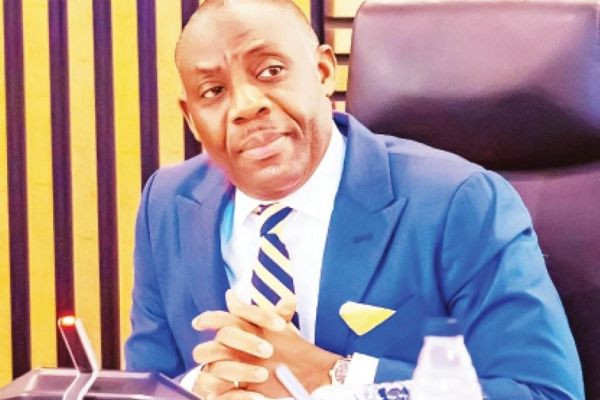
The Federal Government’s decision to exempt candidates seeking admission into Nigerian Certificate in Education (NCE) programmes from sitting for the Unified Tertiary Matriculation Examination (UTME) has generated widespread reactions among education stakeholders, with supporters hailing it as a bold move to revive teacher education and critics warning of potential consequences for academic standards.
The policy, announced by the Minister of Education, Dr. Maruf Tunji Alausa during the 2026 Policy Meeting on Admissions into Tertiary Institutions, is aimed at boosting enrolment in Colleges of Education and addressing the growing shortage of qualified teachers across the country.
Under the new arrangement, candidates seeking admission into NCE programmes with a minimum of four credit passes will no longer be required to sit for the UTME. However, such candidates must still register with the Joint Admissions and Matriculation Board (JAMB) for credential verification and admission processing through the Central Admissions Processing System (CAPS).
Government Defends Policy
Defending the decision, the Minister said available data from JAMB revealed that many Colleges of Education across Nigeria have consistently failed to fill their admission quotas despite having adequate facilities and academic personnel.
According to him, eliminating UTME as an admission requirement for NCE candidates will remove barriers preventing many young Nigerians, particularly those from disadvantaged backgrounds, from pursuing careers in teaching.
The minister maintained that the initiative forms part of broader efforts to expand access to tertiary education, reduce admission bottlenecks and encourage more students to embrace teacher training at a time when the country faces a critical shortage of educators.
Supporters of the policy argue that the waiver could ease the financial burden on prospective students and improve access to higher education for candidates from rural and low-income communities who often struggle with multiple admission requirements.
Stakeholders See Opportunity for Teacher Supply
An education expert and lecturer at Nasarawa State University, Dr. Usman Danladi, described the policy as a strategic intervention capable of expanding access to teacher education.
He noted that removing the UTME requirement could increase the number of candidates entering Colleges of Education and help bridge the shortage of teachers, particularly in underserved communities.
Danladi, however, stressed that the government must complement the initiative with aggressive campaigns aimed at restoring the dignity and attractiveness of the teaching profession.
According to him, increased enrolment would not only strengthen teacher supply but also improve the sustainability of Colleges of Education that have struggled with years of low patronage despite possessing adequate infrastructure and manpower.
Similarly, Executive Secretary of the National Commission for Colleges of Education, Dr. Angela Ajala, defended the policy, insisting that UTME should not be regarded as the sole measure of a candidate’s academic capability.
Ajala argued that the examination primarily serves as a placement and ranking tool rather than an achievement test.
“What is UTME? It is a two-hour examination. It is not an achievement test. Decisions like these were not taken arbitrarily; they were based on evidence, data and projections about the future of teacher education in Nigeria,” she said.
She warned that Nigeria could face a severe shortage of teachers within the next six years if urgent measures are not taken to increase enrolment into teacher-training institutions.
Critics Warn Against Lowering Standards
Despite the government’s justification, opposition to the policy has been swift.
President of the Colleges of Education Academic Staff Union, Dr. Lawal Bazza, faulted both the process and substance of the decision, arguing that major reforms affecting teacher education should emerge from broad stakeholder consultations.
According to Bazza, COEASU was not involved in discussions leading to the policy, stressing that reforms affecting the future of teacher education should adopt a bottom-up approach rather than unilateral implementation.
While acknowledging the need to increase enrolment in Colleges of Education, he cautioned that efforts to attract more students should not come at the expense of quality teacher preparation.
NUT Expresses Reservations
The National President of the Nigeria Union of Teachers, Comrade Titus Amba, also expressed concerns over the policy, warning that it could create the impression that teaching requires lower academic standards than other professions.
Amba argued that teaching should not become a refuge for candidates unable to secure admission into other disciplines, insisting that the profession requires rigorous entry standards capable of producing competent educators.
He lamented the decline of traditional teacher-training institutions and the gradual erosion of professional standards in teacher preparation.
According to him, the real challenge facing teacher education is not admission requirements but the declining attractiveness of the profession due to poor welfare, inadequate incentives and weak policy support.
He pointed to countries such as Finland, where teachers enjoy high social status and competitive remuneration, making teaching a highly sought-after profession.
Experts Call for Broader Reforms
Executive Director of the Education Rights Initiative, Dr. Solomon Udah, argued that the government risks reinforcing the perception that teaching requires lower academic standards by exempting prospective teachers from an admission requirement applicable to other tertiary education candidates.
He maintained that the core problem confronting Colleges of Education is not access but attractiveness.
According to Udah, young Nigerians are not avoiding teacher education because of UTME but because of poor salaries, limited career advancement opportunities, inadequate welfare packages and the low social status attached to the profession.
“Removing UTME addresses a symptom rather than the root causes of declining enrolment,” he said.
Renewed Focus on Teacher Welfare
The debate has once again highlighted the broader challenges facing teacher education in Nigeria.
Stakeholders agree that improving teachers’ welfare remains crucial to attracting talented individuals into the profession.
Education experts have urged the government to prioritise the implementation of the Teachers’ Salary Scale, improve remuneration packages, provide housing and healthcare support, ensure timely promotions and create stronger professional development opportunities.
They argued that countries with high-performing education systems, including Singapore, South Korea and Finland, focus on making teaching attractive rather than lowering entry requirements.
As the debate continues, many stakeholders believe the success of the policy will ultimately depend on whether it is accompanied by comprehensive reforms capable of restoring the prestige, quality and appeal of the teaching profession.
WASSCE: Akeem Lasisi Highlights Common Mistakes Candidates Make in Informal Letter Writing
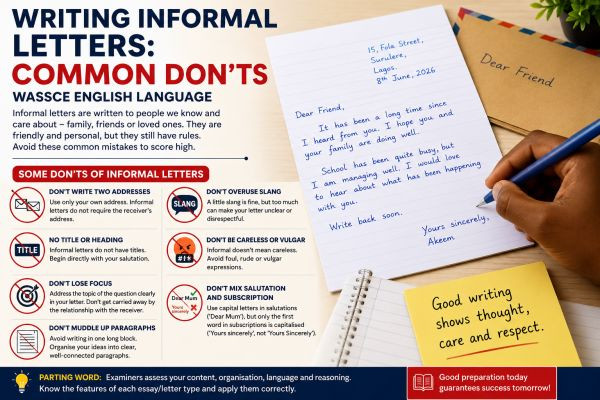
As candidates prepare for the English Language paper in the ongoing West African Senior School Certificate Examination (WASSCE), language expert and educator, Akeem Lasisi, has outlined common mistakes students should avoid when writing informal letters.
Lasisi, in an educational article published on Monday, noted that despite rapid technological advancement and changing communication platforms, letter writing remains a vital aspect of written communication and an important component of English language examinations.
According to him, informal letters are generally easier to write because they are addressed to family members, friends, and acquaintances, allowing for a more relaxed tone than formal correspondence. However, he cautioned that many candidates lose valuable marks by misunderstanding the basic rules governing the format.
Avoid Using Two Addresses
One of the most common errors, Lasisi explained, is the inclusion of two addresses. Unlike formal letters, which require both the sender’s and recipient’s addresses, informal letters require only the writer’s address and date.
Do Not Add a Title
He also advised candidates against adding a title or heading to an informal letter. While formal letters often carry a subject heading, informal letters begin directly with a salutation such as “Dear Mum” or “Dear Friend.”
Stay Focused on the Question
Lasisi stressed the importance of addressing the specific topic given in the examination question. Candidates must clearly understand the purpose of the letter and develop their ideas accordingly.
Whether the task involves narrating an experience, describing an event, discussing family matters, or explaining future plans, students should remain focused on the central theme throughout the letter.
“Being familiar with the recipient should not distract candidates from addressing the requirements of the question,” he noted.
Organise Ideas into Clear Paragraphs
The language expert further warned against writing the entire letter as a single block of text. He encouraged students to organise their thoughts into logical and coherent paragraphs to enhance readability and clarity.
Limit the Use of Slang
Although informal letters permit a conversational tone, excessive use of slang expressions should be avoided. According to Lasisi, overusing slang can make a letter appear unclear and less effective.
Avoid Vulgar or Careless Language
He also reminded candidates that informality does not justify poor language use. Vulgar expressions, offensive remarks, and careless writing should be avoided, even when addressing close friends or relatives.
Observe Proper Letter Conventions
Lasisi highlighted another frequent error involving the salutation and subscription. While salutations such as “Dear Mum” require capital letters, subscription phrases should follow standard conventions.
Examples include “Yours sincerely,” “Your loving son,” and “Your dear daughter,” where only the first word begins with a capital letter.
Master Essay Writing Techniques
Offering broader examination advice, Lasisi urged candidates to remember that English language examiners assess not only content but also reasoning ability, organisation, grammar, and mastery of language.
He advised students to familiarise themselves with the unique features of various essay types, including argumentative essays, debates, speeches, and letters, to maximise their performance in the examination.
With thousands of candidates set to sit for the English Language paper, the guidance serves as a timely reminder that attention to structure, clarity, and language conventions remains essential for success.
Download our Mobile App for easy access
https://play.google.com/store/apps/details?id=com.edutvmobile.ng&hl=en
Mobile App Lite
https://play.google.com/store/apps/details?id=com.edutvng.lite
https://play.google.com/store/apps/details?id=com.edutvmobile.ng&hl=en
Follow us on Youtube
https://youtube.com/@edutvnigeria
Follow us on LinkedIn -
https://ng.linkedin.com/company/edutvnigeria
Follow us on Instagram
https://instagram.com/edutvnigeria
Follow us on Facebook
https://www.facebook.com/edutvnigeria