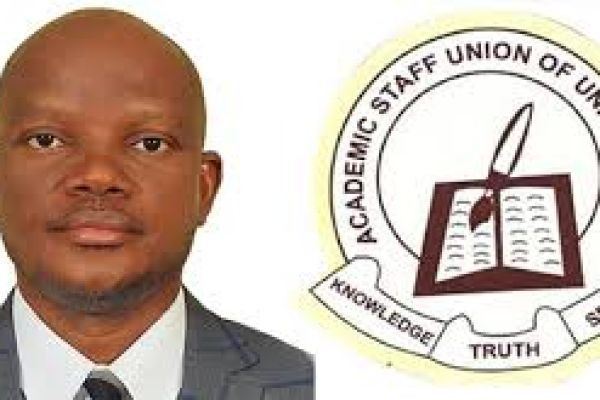
The President of the Academic Staff Union of Universities (ASUU), Prof. Chris Piwuna, has criticised the Federal Government for failing to prioritise education, alleging that top officials do not consider the challenges facing Nigeria’s universities as a shared national concern.
Speaking during The Toyin Falola Interviews in a virtual session titled “A Conversation with the ASUU President” on Sunday, Piwuna expressed frustration over what he described as the government’s persistent indifference to the plight of academic staff and the deteriorating condition of public universities.
“Members of the government, the ministers, and chief executives do not see the problem of education as a problem that affects them,” Piwuna said. “When ASUU declares a strike, the Minister of Finance sees it as the Minister of Education’s problem; the Minister of Science and Technology sees it the same way. But if the Minister of Finance understood that the country’s economic growth depends on a knowledgeable workforce, he would take the Minister of Education’s problem as his own.”
The ASUU President argued that ideological differences and systemic corruption have worsened the situation, noting that education is increasingly treated as a profit-driven venture rather than a public good. He pointed to the controversial suggestion that the Tertiary Education Trust Fund (TETFund) should fund private universities as evidence of misplaced priorities.
“Self-interest and contract inflation have replaced public service. That is why TETFund has become a marketplace,” Piwuna said.
He further lamented the failure of successive governments to honour agreements with ASUU, including the 2009 FGN–ASUU Agreement, which addressed university funding, staff welfare, academic autonomy, and infrastructural renewal.
“The 2009 Agreement remains unimplemented in many areas. Promotion arrears, withheld deductions, and revitalisation funds are still outstanding. Our struggle is not selfish; it’s about saving Nigeria’s public universities from total collapse,” he stressed.
During the discussion, Prof. Toyin Falola highlighted ASUU’s long-standing fight for better funding, remuneration, and university autonomy, describing the union’s activism as both a defence of academic integrity and a reflection of broader governance failures.
Prof. Francis Egbokhare of the University of Ibadan identified poor leadership, weak accountability, and infrastructural decay as core challenges crippling Nigerian universities.
“What is happening is a failure of leadership, especially within governing councils. Poorly constructed buildings in an era of sustainable design reflect weak governance,” he said.
Egbokhare called for leadership reforms and merit-based appointments to reposition the university system, while Prof. Sherrifdeen Tella, an economist, emphasised the neglect of research and innovation as a major factor in Nigeria’s underdevelopment.
“Government agencies should leverage universities for research, consultancy, and technical expertise rather than relying on foreign consultants. It’s not just about money; it’s about sustainable funding models,” Tella noted.
NLC President Joe Ajaero also participated, urging a holistic approach to the education crisis that addresses both tertiary and basic education.
Speaking from the ongoing ASUU National Executive Council (NEC) meeting in Taraba State, Piwuna revealed that discussions with the Federal Government were nearing conclusion but warned that the proposed salary structure remains unacceptable.
“Some of our colleagues sleep in their offices with their families because of poor living conditions. How can such people be expected to drive world-class research? We are still struggling to move out of the 17th century,” he said.
Prof. Piwuna concluded by reaffirming ASUU’s commitment to defending the integrity of Nigeria’s public universities, insisting that constructive dialogue will continue but that the government must treat education as a collective national priority.
“Unless government officials view education as a shared responsibility, Nigeria’s university system will remain trapped in recurring crises that undermine national progress,” he warned.
follow us on whatsapp
https://whatsapp.com/channel/0029VaAOIUe9mrGeBhrju12b
Download our Mobile App for easy access
https://play.google.com/store/apps/details?id=com.edutvmobile.ng&hl=en
Mobile App Lite
https://play.google.com/store/apps/details?id=com.edutvng.lite
https://play.google.com/store/apps/details?id=com.edutvmobile.ng&hl=en
Follow us on Youtube
https://youtube.com/@edutvnigeria
Follow us on LinkedIn -
https://ng.linkedin.com/company/edutvnigeria
Follow us on Instagram
https://instagram.com/edutvnigeria
Follow us on Facebook
https://www.facebook.com/edutvnigeria/